CleanPlex OncoZoom Cancer Hotspot Kit

Price range: $546.00 through $18,144.00

The CleanPlex® OncoZoom® Cancer Hotspot Kit is a multiplex PCR-based targeted resequencing assay designed for rapid cancer profiling of somatic mutations across the hotspot regions of 65 oncogenes and tumor suppressor genes.

Additional pack sizes may be available. Please contact your local sales representative to learn more about additional pack sizes and bulk pricing.

- +
SKU: N/A Categories: , Tag:

Product Documents

Product Description

The CleanPlex OncoZoom Cancer Hotspot Kit is a multiplex PCR-based targeted resequencing assay designed for rapid cancer profiling of somatic mutations across the hotspot regions of 65 oncogenes and tumor suppressor genes. Starting with just 100 pg of high-quality genomic DNA, sequencing-ready libraries can be prepared using a single-tube workflow in just 3 hours. The panel is optimized to deliver data with high on-target performance and high coverage uniformity to ensure efficient use of sequencing reads.

Highlights

  • Relevant Gene Content
    Target 2,900+ hotspots in 65 genes with known cancer associations
  • Fast, Single-Tube Workflow
    Generate sequencing-ready libraries in just 3 hours using a three-step, single-tube protocol
  • Superb Performance
    Prepare high-quality NGS libraries with excellent on-target performance using CleanPlex Technology to enable efficient use of sequencing reads and reduce costs
  • Compatible with difficult samples including single cells
    Short amplicon size design works well with fragmented DNA from FFPE, ctDNA from blood cfDNA, DNA from single circulating tumor cells and other clinical samples; The specific user guide for single cell can be found here

The CleanPlex OncoZoom Cancer Hotspot Kit contains CleanPlex Multiplex PCR Primers and CleanPlex Targeted Library Kit. CleanPlex Indexed PCR Primers and CleanMag® Magnetic Beads are ordered separately to complete the workflow from input DNA to sequencing-ready NGS libraries.

Paragon Genomics has partnered with VarSome Clinical to provide a full solution for fast and accurate variant discovery, annotation, and interpretation of next-generation sequencing data for targeted gene panels. Click here to find out more!

Storage Temperature

Store at -20 °C.

For Research Use Only. Not for use in diagnostic procedures.
Product Documents

Additional Information

Weight4 g
Dimensions30 × 50 × 20 cm
Pack Size (Reactions)

8, 96, 384

How much DNA should I use to detect 1% somatic variant frequency?

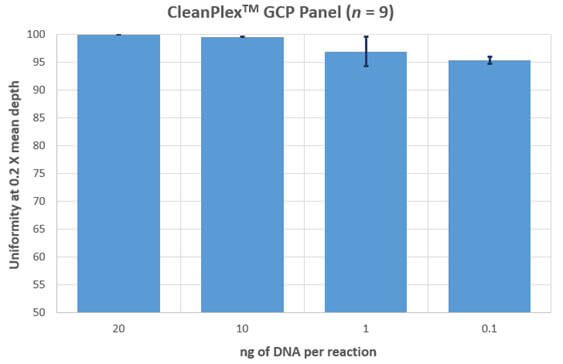
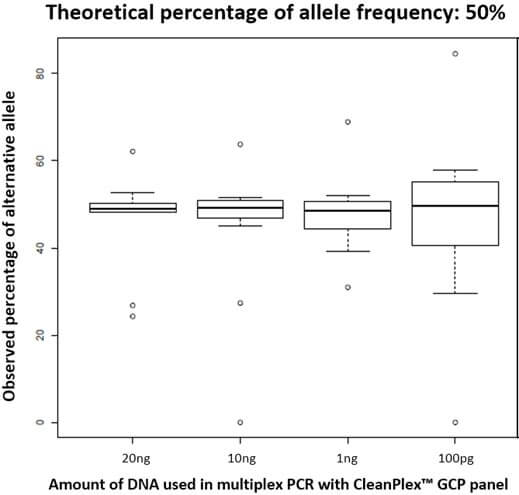
Lower DNA input will generally increase the possibility of inaccurate calling of variant frequencies. As shown in the following figure on the left, when less and less DNA was amplified with CleanPlex™ OncoZoom Panel, increasingly larger variations were observed for calling alternative alleles at 50% frequency, even though the uniformity may not deteriorate significantly (figure below on the right). Therefore, we recommend using higher amounts of DNA for somatic variant detection. This is especially true when DNA quality is uncertain (such as DNA from FFPE tissues and liquid biopsy). Theoretically, 10 ng human DNA (~1500 cells and ~3000 copies of each locus) will allow detection of 30 somatic alternative alleles at 1% frequency. With CleanPlex® technology, lower amount (even less than 1 ng) of high-quality genomic DNA may be used for detection of germline alterations.
      

There is little or no library peak when assayed with a fragment analyzer.

Possibilities include:

  • Using incompatible index primers.
  • DNA quantification was inaccurate, especially if using spectrophotometric methods such as nanodrop, OR DNA quality is extremely poor.
  • 30% ethanol instead of 70% ethanol OR using TE/H2O instead of 70% ethanol was used in DNA purification.
  • Forgetting to add magnetic beads for any of the purification steps.
  • Forgetting to add one or both index primers in the 2nd PCR step.
  • Over-digestion, forgetting to add Stop Buffer after digestion, or pausing after digestion step.
  • Weak or incompatible magnetic rack. Do not use racks designed for 1.5 ml tube.

What is the typical yield of a Cleanplex® library?

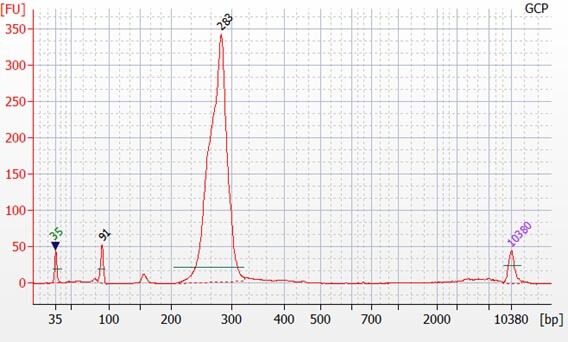
CleanPlex® workflow generates a single peak of library at approximately 8,000 – 20,000 pM when measured with a fragment analyzer such as Agilent™ 2100 Bioanalyzer instrument and Agilent™ high sensitivity DNA reagents, or approximately 1.5 – 4 ng/µl when measured by Qubit™ dsDNA HS Assay Kit, depending on each specific panel. It is good practice to QC completed library with a fragment analyzer to confirm the quality of the library prior to sequencing. Qubit measurements only give the total yield, and does not indicate if the library was poorly prepared and had resulted in large amount of byproducts.

Concentrations higher or lower than the typical range of yields may lead to lower uniformity due to uneven amplification of target regions. Concentrations much lower in concentration can prove to be difficult to satisfy Illumina’s loading criteria. Please refer to Illumina’s suggestions for minimum loading concentration and volume.

What should I do when the library yield is lower or higher than expected?

Increase or decrease the number of cycles for the 2nd PCR by 2 to 3.

What are the peaks around 70 – 90 bp in addition to the main library peak on a fragment analyzer trace?

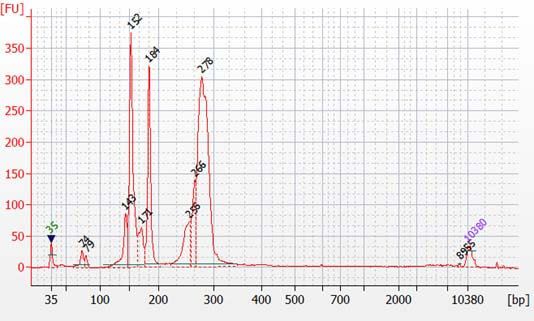
Peaks from 70 – 90 bp (see the trace below) are primer dimers from the 2nd PCR and result from incomplete removal of small molecular materials during the final magnetic bead purification. These are usually caused by inaccurate pipetting of magnetic beads when working with a large number of samples at once OR insufficient removal of supernatant  and ethanol during washing steps. If these peaks are significant, one can pool all indexed libraries (that will be sequenced in the same lane) and perform one additional round of 1.2X magnetic bead purification, before the quantification step prior to sequencing.

What is peak around 150 -190 bp in addition to the main library peak on the fragment analyzer trace?

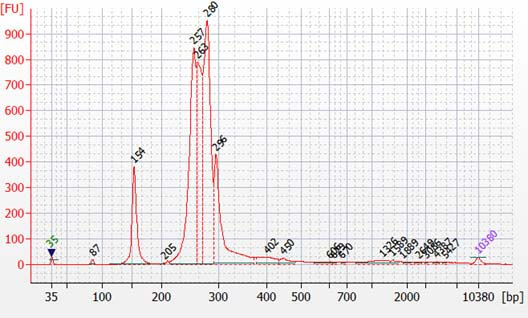
Peaks from 150 – 190 bp are residues of digested non-specific amplification products (see examples below).

They come from incomplete removal of small-molecular-weight materials during magnetic bead purification after digestion. The digestion reagent cuts non-specific amplification products into small pieces, which are then removed during magnetic bead purification. Peaks from 150 – 190 bp are usually caused by the following:

Insufficient mixing of solutions: 
Mix all working solutions and magnetic bead + sample solutions thoroughly prior to PCR and incubation steps. Vortex or pipette mix as needed to ensure solutions are homogeneous.
Inaccurate magnetic bead volume:
Again because we’re working with small volumes, it’s important to add accurate volume of beads (see 2nd page of quick guide for details). The specific bead ratio is critical for size selection in removing the smaller fragments, therefore it is crucial that the bead+sample solution is thoroughly mixed to ensure the bead to sample ratio is the same throughout.
Forgetting to add 10 uL of TE for single pool panels after mPCR:
This error is also related to bead to sample volume ratio. Add 26 uL of bead solution to 20 uL of sample ( 10ul of mPCR product + 10 uL TE) for the first purification step.
Poor Ethanol Washes:
With extremely poor ethanol washes, there can be significant carry over of byproducts to 2nd PCR step, and are then preferentially amplified. Take care to remove all supernatant after bead incubation (following the second quick spin step 5, 4, &4 on each of the purification sections), and the ethanol from the second ethanol wash of each purification step.
Extremely low or poor quality DNA input: 
First, minimize freeze thaw cycles for low concentration DNA samples (<10ng/uL). Always determine the DNA concentration immediately prior to library preparation instead of days before. Higher quality samples and higher sample input tends to yield higher quality libraries with less by products.
Some custom panels might be more likely to have these products as compared to other due to the unique nature of some custom designs. If this is the case, one can perform an additional 1.3x bead to sample volume purification after the digestion step. Or one can pool all indexed libraries (that will be sequenced in the same lane) and perform one additional round of 1.2X magnetic bead purification, before the quantification step prior to sequencing.

What are the AT and GC biases of CleanPlex® target enrichment libraries?

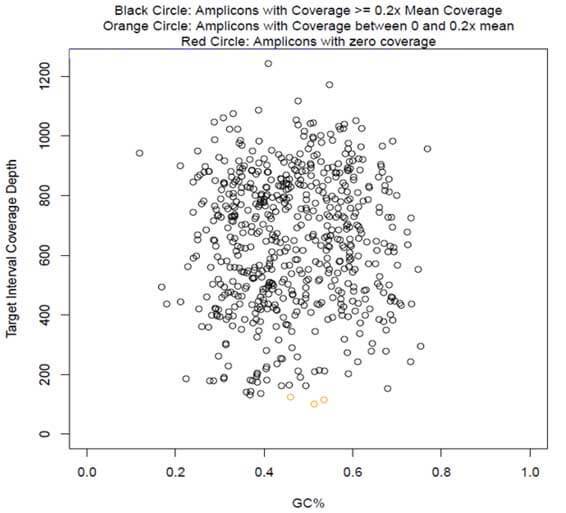
The observed AT and GC dropouts are below 3% in CleanPlex® target enrichment libraries. Below is a typical graph of Coverage Depth vs. GC Content of a library made with CleanPlex® OncoZoom Panel.

You may also like…

CleanPlex Amplicon Sequencing Library Kit Product ImageCleanPlex OncoZoom Cancer Hotspot Kit
Price range: $546.00 through $18,144.00Select options